Wellness Hero: Refining the Journey
Production Update | Summer 2026
Since our last update, we’ve been refining how Wellness Hero’s systems work together and how players learn to use them. Our mobile emotional-energy management game asks players to navigate daily challenges, develop wellness techniques, maintain support relationships, and decide when to rest.
Alongside producing and directing the project, I lead its game design and playtest extensively. That work informs our priorities, from the balance between effort and recovery to the way a finger obscures or informs visual cues. Working across programming, art, and design, we’ve translated those observations into changes to gameplay, onboarding, and mobile interaction.
Play Wellness Hero on Android: [Link]
Build FQA Playtesting 0.2.07
Try the daily challenge loop, explore the Wellness Shield, and see how your choices affect energy and rest.
Daily Challenges, Energy, and Rest
Players connect their Hero to daily challenge towers, allocating emotional energy to complete them. The Sleep system carries the consequences into the next day: attempting too much can reduce sleep quality and leave less energy available tomorrow.
I designed this relationship to make rest a meaningful strategic decision. Clearing another challenge may help today, but players also need to consider what it will cost them tomorrow. Wellness techniques and support relationships introduce additional ways to approach those demands.
We’ve refined the Hero’s energy feedback to reflect connected towers and adjusted the Sleep Tower’s placement and visibility. During playtesting, I found that locating the Sleep Tower could itself become an obstacle. Ending the day is a central decision, so its interface needs to be immediately recognizable.
The Depression system changes the conditions under which those decisions are made. Increased challenge costs, tower scale, and altered lighting work together to represent familiar responsibilities becoming harder to manage. We’ve continued refining the lighting and interface indicators, and restored the Depression Effects Mode toggle in Settings.
[SCREENSHOTS: A readable mid-game board and its Sleep information panel. If possible, show how changing the energy connections changes the predicted sleep outcome. A comparable board during a depression wave could illustrate the visual and mechanical contrast.]
Wellness Techniques and Relationships
Your Wellness Journey offers groups of techniques for players to choose from. The Wellness Shield holds techniques they can use, while Journey Paths and Integration provide longer-term progression.
My design goal is to connect immediate decisions with a developing strategy. A technique should help with the current situation while also contributing to the player’s longer-term approach. Our playtesting examines whether the choices between groups are understandable and whether strategies emerge around particular Journey Paths.
We’ve addressed Integration errors, improved access to research information, and refined the handling of badges and menus. These changes help players move between choosing a technique, using it, and understanding its role.
Support System members and Romantic Partners bring relationships into the game’s resource-management decisions. We enlarged their naming fields to make personalization easier on a phone. We also changed the Support System menu flow after I observed that placing a member returned me to a menu when my next instinct was to interact with that person on the board. The revised flow returns players directly to play.
[SCREENSHOTS: Your Wellness Journey’s selection screen, the Wellness Shield with integrated techniques, and a named Support System member on the field. Choose two images that best explain the connection between selection and use.]
Clearer Controls and Feedback
Our first Your Day interaction exposed a basic onboarding problem. Players could see the badges without understanding that they needed to drag one onto the field. I proposed demonstrating the action within the menu: move a badge downward, return it to its starting position, and repeat until the player performs the gesture. We implemented that animation alongside the tutorial text.
Touchscreen playtesting revealed another problem with Mantra placement. The red and green target indicators communicated valid and invalid positions, but my finger covered the information precisely when I needed it. I specified larger, thicker circles, and we updated the indicators to remain visible around the touch point.
These revisions follow the same principle: introduce an action where it is needed, then make its result perceptible.
We’ve also added haptic feedback to four core interactions: linking, placing a Mantra, placing an Intervention, and placing a tower. The intended feeling is gentle confirmation. Visual, tactile, and interface feedback should agree about what just happened.
[CAPTURES: A short GIF of the Your Day tutorial animation and a screenshot of the enlarged Mantra placement indicator. For a static devlog, use two frames to demonstrate the tutorial gesture.]
Building and Playtesting in Unity
Following our Unity 6 transition, we worked through a broader refactor and successive Android builds. We tested the connections among gameplay state, saving, menus, tutorials, and visual feedback. Fixes included save failures, a weekend soft lock, and problems linking to relationship characters.
I structure our playtesting around both functional checks and design questions. ClickUp groups numbered bugs and enhancements beneath the build being tested, helping us connect observations to particular versions. Testing instructions ask team members to record the time required to play 30 in-game days, track progression, investigate sleep outcomes, and compare play with and without depression effects.
Three questions guide that work:
Can I play fast?
Is it fun if I learn nothing about wellness?
Do strategies emerge?
These questions keep us accountable to the experience of playing. Our educational intentions need to become worthwhile decisions, readable feedback, and reasons to continue.
I frequently organize my playtest feedback as Observation -> Impact -> Next Action. An indicator disappears beneath a finger. The player cannot judge placement. We enlarge the indicator. This gives collaborators the reasoning behind a request while leaving room to discuss the best implementation.
We’ve also implemented Share Your Journey, which generates an image players can share through their phone. Together with the interface and gameplay refinements, it gives us another way to examine how players understand and communicate their progress.
[SCREENSHOTS: A share image generated by the app. Optionally pair a mobile gameplay capture with the corresponding Unity scene or interface to show the development context.]
The process continues to inform my teaching: make the design concrete, put it into someone’s hands, observe closely, and revise with purpose. On Wellness Hero, we practice that process together, one build and one player interaction at a time.

JANUARY 2025
Production Update 1/05/25
We have completed our Minimum Viable Product and are preparing some social media sharing features to be ready for Beta Testing. We’re making significant progress toward a 2025 launch on iOS and Android!
WELLNESS HERO continues to evolve as a video game for social impact, simulating depression, teaching coping skills, and spreading awareness. Since our last update, we’ve expanded the core gameplay with a new "Pathology Plugin" to simulate Depression and added an interactive call-to-action feature for instant mental health support. These additions deepen the game's purpose as a gamified psychoeducation tool based on CBT, MBSR, and Maslow’s hierarchy of needs.
Notable updates include balancing gameplay, expanding the Journey Paths skill tree, and doubling the number of Daily Challenge events and Wellness Techniques. Feedback from several closed beta tests revealed the need for a clearer onboarding experience, which we’ve addressed with a detailed step-by-step walkthrough for new players.
We’ve also ported the game to Unity 6, enabling broader optimization, and began Beta Testing for Android in addition to iOS.
To prepare for launch, we’ve expanded the Ensemble Interactive website at www.EnsembleInteractive.com to include the beginnings of a press kit, anticipating a comprehensive marketing campaign later this year. Additionally, we’ve been actively Devlogging on our Instagram and other socials at https://www.instagram.com/ensembleinteractive/, where you can find concept art and detailed explanations of our process. As a professor, documenting this project’s process has been a priority to offer insights into its development.
Producer, Creative Director - David Negrin
Art Lead - Hannah Barone
Code Lead - Carson Moon
Design Lead - Donovan Mercado
Marketing Lead - Maxwell Neale

Production Blog
Production Update 5/25/24: We’re in the last 4 weeks of production, and should be Beta Testing in April on target for a Summer 2024 Release on iOS and Android.
WELLNESS HERO is a video game for social impact that simulates depression, teaches coping skills, destigmatizes mental health challenges, and spreads awareness. The casual emotional energy management game transforms the CBT & MBSR based “Spoon Theory” concept into a gamified psychoeducation experience. A framework based on Maslow’s hierarchy of needs. The final game will include in-game interactive calls to action for advocacy, donation, and crisis support through mental health non-profit partners. Designed for mobile iOS and Android platforms on the Unity game ending. (Previously ‘Waves’)
Producer, Creative Director - David Negrin
Art Lead - Hannah Barone
Code Lead - Carson Moon
Design Lead - Donovan Mercado
Marketing Lead - Maxwell Neale

EXPANDED DAILY CHALLENGES

EXPANDED WELLNESS TECHNIQUES

NEW ONBOARDING & TUTORIAL

INTERACTIVE CALL TO ACTION FOR SUPPORT
Wellness Hero First LookTrailer 0.1

Prototypes & Game Balancing
One of our latest prototypes next to a concept of the field. Once core gameplay was built in the Unity project, we could begin playtesting and iterating on balancing the fun, difficulty, and social impact goals of WH.
Art Style & Game Space
Finding the art style and color palette is an ongoing process between our Art Lead and Creative Director. Our goals were a casual game interface, with metaphorical elements, where strategies will emerge intuitively while subtly achieving our psychoeducation impact goal.

Menu & UI Concepts
These menu and user interface concepts represent an intermediate version of a simplified game loop.

Badge Concepts & Sprites
Journey Interventions and Day Events are represented in game by badges that communicate the journey path or the life area of your daily tasks.

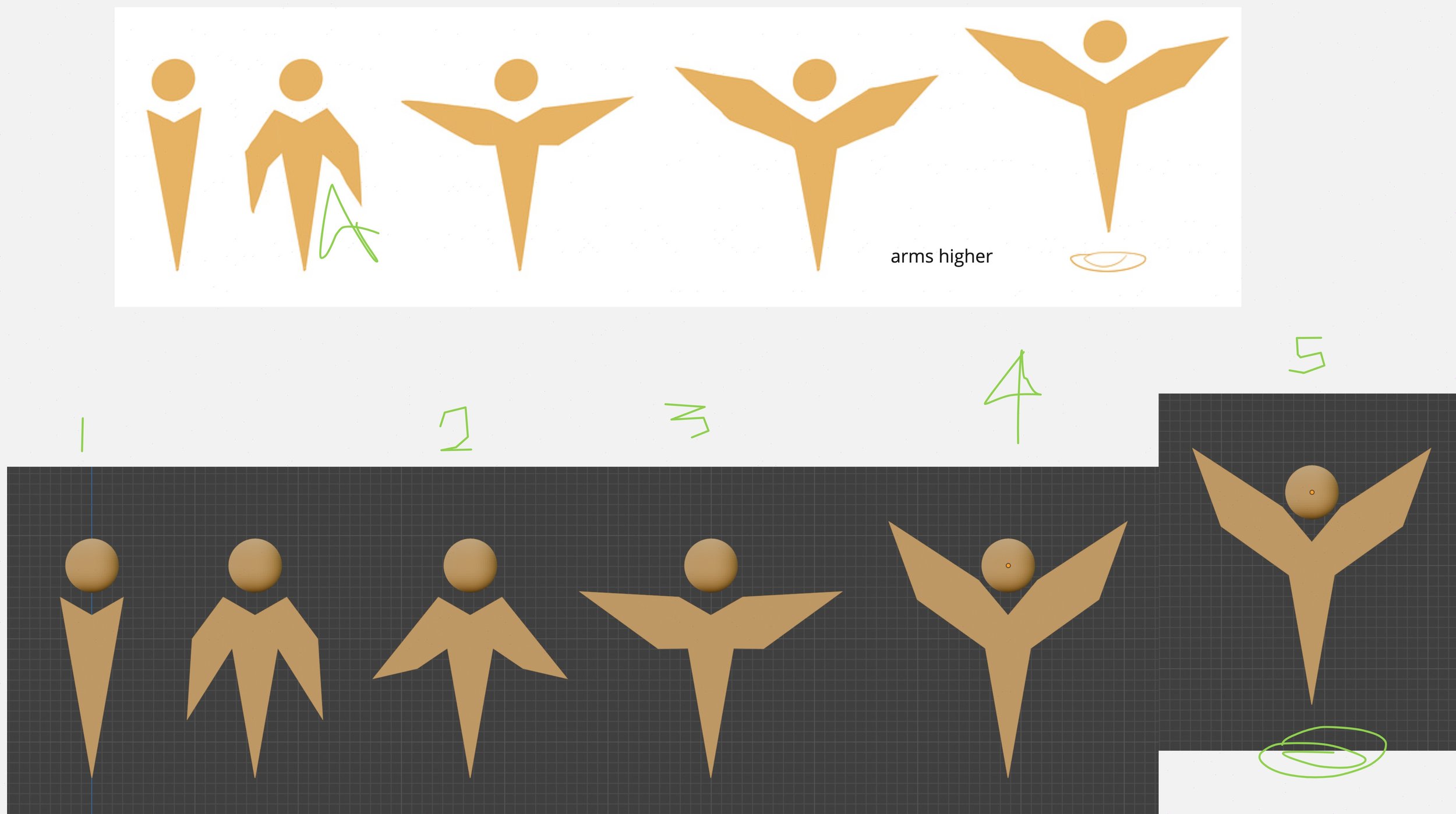
Hero Concepts & Models
We worked through multiple concepts for the ‘Hero’ figure from humanoid to completely abstract to somewhere in between. The variations below represent the increased awareness of the player as they level up in their wellness journey.
Game Loop & Ruleset Refinements
Transitioning from the tabletop prototype to the video game project allowed us to scale down a complex ruleset and refine the game loop.


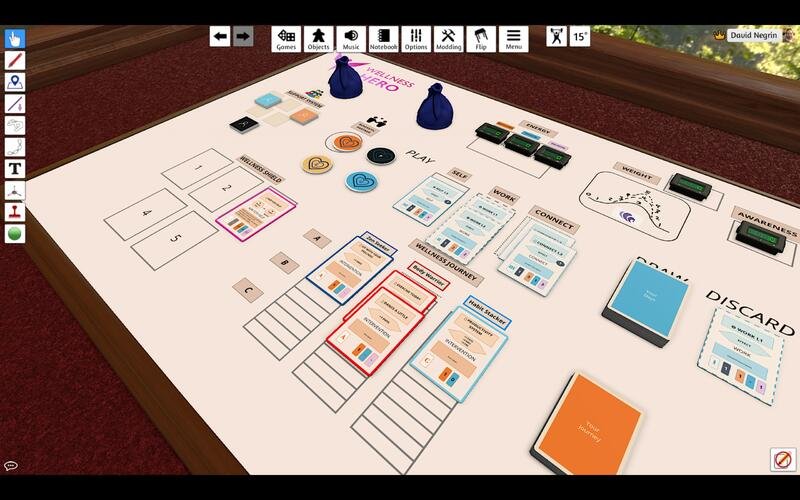
Design & Paper Prototype
Design of Wellness Hero began with a table top “paper prototype” to iterate on the core gameplay, the early rules set, and its social impact goals. It was created with pen and ink sketches, Table Top Simulator, and Photoshop.

Concept & Ideation
Concepting of Wellness Hero began with an iGDD, or interactive game design document, combining my ideation, references, social impact aspirations with game mechanics, game art, and game narrative.
Interactive GDD & Prototypes